

Showing posts with label PHD. Show all posts
Showing posts with label PHD. Show all posts
Friday, August 14, 2015

Tuesday, August 11, 2015
Writing Thesis & Journal Paper with Ease using LaTeX

Open for another 6 registration ONLY.
Limited to 20 Pax per class.
Register Now at Promotion Rate : RM 190.80
to register:
http://
or may direct call 03-89127212
Limited to 20 Pax per class.
Register Now at Promotion Rate : RM 190.80
to register:
http://
or may direct call 03-89127212
Friday, August 7, 2015
Research Methodology

Qualitative Research
Qualitative research seeks to explore a specific phenomena, not prove a prediction, according to "Qualitative Research Methods: A Data Collector's Field Guide," published by Family Health International. Often used in the social sciences and education, qualitative methodologies use interviews, focus groups and observations to collect data. Qualitative methods provide rich, contextual explorations of the topic that are often personally or culturally meaningful.
Quantitative Methods
Quantitative research is is more objective than qualitative methods. In this type of methodology, the researcher crafts a hypothesis and then tests it through structured means. Instead of exploring or describing a phenomena, quantitative methods deal with facts and statistics. This type of research is often used in science or medicine.
Mixed Methods
Mixed methods combine qualitative and quantitative research. This type of methodology uses several different measures that include both contextual understanding like interviews or observations along with facts or statistics. Using mixed methods can help the researcher investigate a topic on multiple levels, gaining different views and a comprehensive look at the subject. A mixed methodology meshes more than one philosophical perspective, allowing for the integration of different theories and ideas.
Methodologies and Design
Within each major methodology are various designs. These provide a framework or philosophy for the study, and are different than the actual methods used. For example, a case study design focuses on exploring and describing a specific instance, person or group. A researcher may use observations, interviews or self-reports from the subject to create a complete picture. This picture, or case, provides a detailed example of a phenomenon that can then be generalized to a similar population.
Workshop : http://bit.ly/
Read more : http://www.ehow.com/
Monday, July 13, 2015
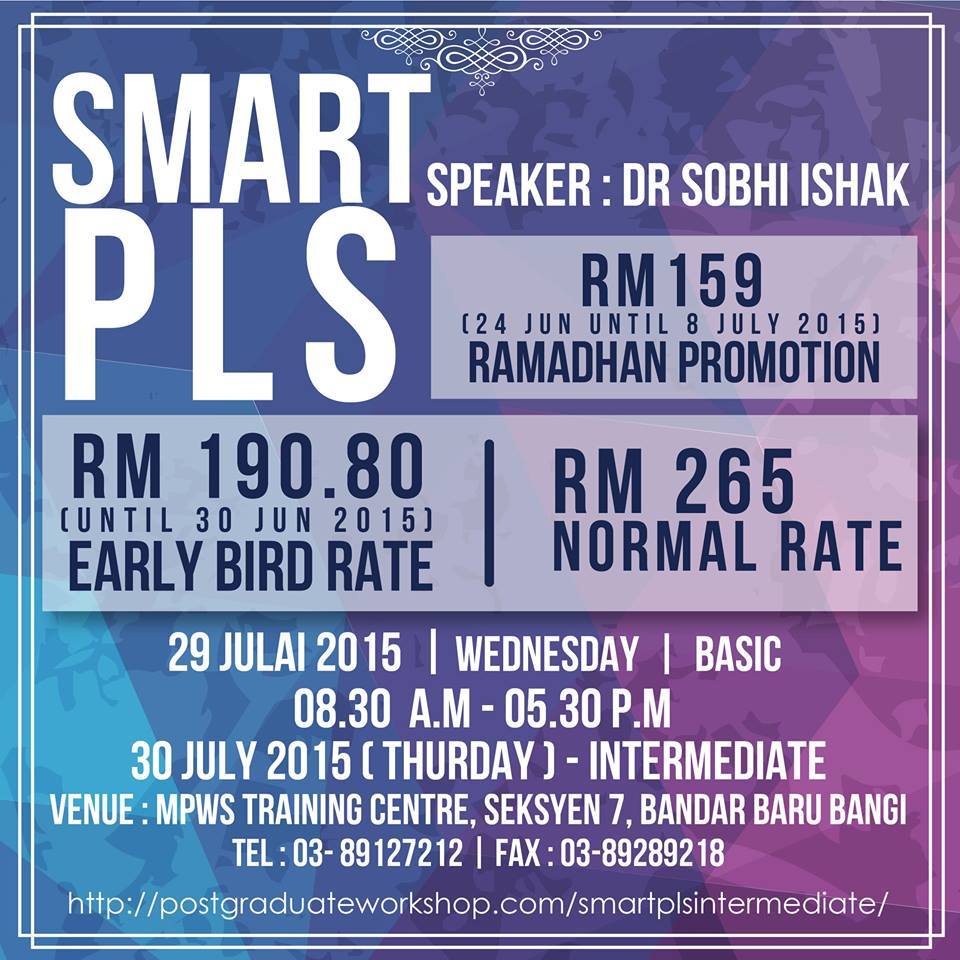
Friday, April 24, 2015
One Day Workshop on Research Tools: Supporting Research and Publication
[PERSIAPAN AWAL]
Adakah anda tahu, sebelum anda memulakan langkah anda sebagai pelajar Postgraduate, rupa-rupanya ada teknik yang boleh membantu untuk memilih Supervisor (SV) yang tepat, di mana kita boleh 'check' latar belakang SV contohnya sudah berapa jurnal yang diterbitkan oleh seseorang SV itu, link atau 'networking' sesorang SV dengan universiti lain di dalam dan luar negara, conference yang pernah disertainya dan sebagainya.
Adakah anda tahu, sebelum anda memulakan langkah anda sebagai pelajar Postgraduate, rupa-rupanya ada teknik yang boleh membantu untuk memilih Supervisor (SV) yang tepat, di mana kita boleh 'check' latar belakang SV contohnya sudah berapa jurnal yang diterbitkan oleh seseorang SV itu, link atau 'networking' sesorang SV dengan universiti lain di dalam dan luar negara, conference yang pernah disertainya dan sebagainya.
Tunggu...
Banyak lagi teknik-teknik lain lagi yang anda perlu tahu sebelum anda memulakan langkah di dalam dunia kajian.
Ketahui teknik dan method yang sesuai untuk mencari sumber seperti jurnal, artikel atau bahan sebelum memulakan kajian anda.

Sebagai persediaan awal sebelum meneruskan dengan ‘Research Proposal’
anda supaya anda boleh mendapat gambaran awal dalam memilih method yang
paling sesuai untuk digunakan.
Dapat idea menyeluruh di mana hendak memulakan kajian anda.
Cara untuk mencari topik/tajuk kajian dengan menggunakan kata kunci
yang sesuai digunakan untuk mencari bahan-bahan yang membantu kajian
anda.
Bagi tajuk-tajuk tertentu, kata kunci memainkan perananan
kerana kata kunci yang tepat membolehkan research itu sendiri mudah
dijumpai oleh orang lain. Dengan itu, tidaklah kajian yang diusahakan
itu menjadi tidak sia-sia.
Ketahui bagaimana meningkat ‘citation’ daripada researcher lain.
Ketahui bagaimana dapat mengelakkan ‘plagiarism’ menggunakan cara
tertentu, memastikan ‘paraphrasing’ yang dibuat itu masih belum
dikategorikan sebagai plagiat.
Beberapa tips terbaik daripada penceramah.
Date: 30 May 2015 (Sabtu)
Time: 8.30 a.m. - 5.30 p.m.
Venue: Bandar Baru Bangi
Speaker: Dr. Nader Ale Ebrahim, PhD
Yuran : Early Bird RM 190.80 Normal Rate: RM265.00 ****till 29 April 2015
Medium: English
Time: 8.30 a.m. - 5.30 p.m.
Venue: Bandar Baru Bangi
Speaker: Dr. Nader Ale Ebrahim, PhD
Yuran : Early Bird RM 190.80 Normal Rate: RM265.00 ****till 29 April 2015
Medium: English
p/s:Jom dapatkan early bird rate
Tuesday, April 21, 2015

Monday, April 13, 2015
Apa itu SMART PLS?
SMART PLS banyak digunakan untuk menganalisis SEM
berbasis komponen. Merupakan teknik alternatif dari SEM berbasis
variance seperti AMOS dan LISREL. Software ini dikembangkan oleh
institute of Hamburg Jerman dan dapat didownload gratis (tapi harus
register terlebih dahulu) SmartPLS adalah aplikasi perangkat lunak untuk
(grafis) pemodelan jalur dengan variabel laten (LVP). The partial least
squares (PLS)-method (PLS) yang digunakan untuk analisis LVP-in
software ini.
Smart PLS menggunakan bahasa JAVA, jadi sebelum menggunakan SmartPLS ada baiknya diinstall terlebih dahulu Java Runtime Environment (JRE) yang juga dapat didownload gratis di situs Sun Microsystem.
Smart PLS menggunakan bahasa JAVA, jadi sebelum menggunakan SmartPLS ada baiknya diinstall terlebih dahulu Java Runtime Environment (JRE) yang juga dapat didownload gratis di situs Sun Microsystem.
| » | Ciri Algoritma PLS-SEM | ||||||||||
|
| » | Ciri Data | |||||||||
|
| » | Ciri Model | |||||
|
| » | Kelebihan SmartPLS | |||||
|

Thursday, April 9, 2015
Seminar JOM HEBAT Siri 8.0

Perkongsian ilmu daripada 5 orang sifu diteruskan. Kali ini tempat di had kepada 200 orang peserta sahaja.
SEMINAR JOM HEBAT PASCASISWAZAH I 6 JUN 2015 (SABTI) I 8.00 pagi -5.00 petang I MPWS Training Centre, Bandar Baru Bangi, Selangor.I
>>>> http://
TEMPAT ADALAH TERHAD !!!!
Antara perkara yang akan dikongsikan adalah seperti berikut:-
* HEBAT bersama En Shuhairy Norhisham “Teknik Komunikasi dengan Supervisor”
* HEBAT bersama Madam Ani Munirah “Jom Analisa Data Kualitatif dengan ATLAS.ti”
*HEBAT bersama Prof Zainudin Hj Awang “Cadangan Penyelidikan & Amos”
*HEBAT bersama Dr Nor Azwadi Che Sidik “Publish and Flourish”
*HEBAT bersama Dr Othman Talib “Tulis Tesis Pantas “
Untuk maklumat mengenai pembayaran dan pendaftaran secara online, sila rujuk:- >>>> http://
Tuesday, March 24, 2015
One Day Workshop on Literature Review using ATLAS.ti
Just nak share;
Betapa takutnya memulakan penulisan Literature Review (LR)/ Sorotan Literature
Cemas sangat bila SV selalu suruh cari yang updated paper dan cari gap dalam LR
Dan paling kalut bila dah print "manyak-manyak" paper; siap highlight colour warna-warni then terlepas pandang atau tak ingat letak mana?
BETUL TAK???
Manusia...Biasa le..Tapi kini TIDAK lagi.
Setelah menghadiri kelas ATLAS.ti LR, Semuanya di hujung jari.
--------------------------------------------------------------------------------
Antara perkongsian yang bakal dikongsikan bersama anda adalah 'Literature review' menggunakan ATLAS.ti:
1. Download artikel
2. Import ke dalam ATLAS.ti
3. Membaca sambil highlight menggunakan cursor, kod berdasarkan tema penulisan
4. Berikan arahan kepada ATLAS.ti untuk keluarkan ke-SEMUA points penting daripada ke-SEMUA artikel mengikut susunan tema penulisan dalam bentuk SATU dokumen baru
5. Tulis review berdasarkan points penting yang telah dihasilkan daripada fungsi output ATLAS.ti.

Butiran bengkel adalah seperti berikut:
Course Title : One Day Workshop on Literature Review using ATLAS.ti
Tarikh: 10 April 2015 (Jumaat)
Masa: 8:30 a.m. – 5:30 p.m.
Tempat: MPWS training centre
Penceramah: Ani Munirah Mohamad (Certified ATLAS.ti Trainer)
Bahasa Penghantar: English
BERMINAT?
Sila tinggalkan email anda untuk menerima maklumat lanjut atau pendaftaran langsung dalam talian di -> http://bit.ly/atlastiLR
ATAU
► Sms/WhatsApp + 6012 5430105 (Ayuni) for more info: Specify the course title and date.
Betapa takutnya memulakan penulisan Literature Review (LR)/ Sorotan Literature
Cemas sangat bila SV selalu suruh cari yang updated paper dan cari gap dalam LR
Dan paling kalut bila dah print "manyak-manyak" paper; siap highlight colour warna-warni then terlepas pandang atau tak ingat letak mana?
BETUL TAK???
Manusia...Biasa le..Tapi kini TIDAK lagi.
Setelah menghadiri kelas ATLAS.ti LR, Semuanya di hujung jari.
--------------------------------------------------------------------------------
Antara perkongsian yang bakal dikongsikan bersama anda adalah 'Literature review' menggunakan ATLAS.ti:
1. Download artikel
2. Import ke dalam ATLAS.ti
3. Membaca sambil highlight menggunakan cursor, kod berdasarkan tema penulisan
4. Berikan arahan kepada ATLAS.ti untuk keluarkan ke-SEMUA points penting daripada ke-SEMUA artikel mengikut susunan tema penulisan dalam bentuk SATU dokumen baru
5. Tulis review berdasarkan points penting yang telah dihasilkan daripada fungsi output ATLAS.ti.
Butiran bengkel adalah seperti berikut:
Course Title : One Day Workshop on Literature Review using ATLAS.ti
Tarikh: 10 April 2015 (Jumaat)
Masa: 8:30 a.m. – 5:30 p.m.
Tempat: MPWS training centre
Penceramah: Ani Munirah Mohamad (Certified ATLAS.ti Trainer)
Bahasa Penghantar: English
BERMINAT?
Sila tinggalkan email anda untuk menerima maklumat lanjut atau pendaftaran langsung dalam talian di -> http://bit.ly/atlastiLR
ATAU
► Sms/WhatsApp + 6012 5430105 (Ayuni) for more info: Specify the course title and date.
Wednesday, March 11, 2015
Bagaimana dengan TESIS anda????
Masih keliru dengan Keadah kajian Anda??????
Tidak pasti sama ada ingin menggunakan Kajian KUANTI @ KUALI????
Aaaaaa stresss nya....
Kami ada jalan penyelesaian.......
Buat
julung kalinya kami akan mengadakan Seminar khusus bagi pelajar
Pascasiswazah yang menjalankan penyelidikan menggunakan keadah
KUANTITATIF.
BERMINAT?????
Tawaran istimewa!!!!
Tempat adalah terhad.
| |||||||||||||||||||||
|
APA YANG AKAN DIBINCANGKAN...........
1) APA, MENGAPA, KENAPA, dan BAGAIMANA kajian kuantitaif ini membantu anda dalam menghasilkan penyelidikan tesis.
2) Membantu anda dalam merangka soalan kaji selidik
3) Akan menerangkan keadah dan cara terkini dalam kajian kuantitatif.
Seminar ini terbuka kepada
semua pelajar pascasiswazah / pensyarah / tutor dan pelajar tahun akhir sarjana muda.
Friday, February 13, 2015


Wednesday, February 4, 2015
Testimonies


Come join us!!!
One day Workshop on Literature Review by Using ATLAS.ti
Date: 13 February 2015
Time : 8.30 am - 5.30 pm
Venue : MPWS Training Centre
Fee : RM 250 (included meals & certificate)
Speaker : Madam Ani Munirah Mohamad (Certified ATLAS.ti trainer)
Regional Manager for Training & Partnership Development
at ATLAS.ti Scientific Software Development GmbH
To register online Regional Manager for Training & Partnership Development
at ATLAS.ti Scientific Software Development GmbH
http://postgraduateworkshop.com/lratlas.ti
Wednesday, December 24, 2014
Seminar Jom Hebat Pascasiswazah Siri 7
DEWAN KULIAH PUSAT 4, UNIVERSITI SAINS ISLAM MALAYSIA (USIM).
Tarikh: 31 Januari 2015 (sabtu)
Masa: 8.00 am - 5.30 pm
Tempat: DEWAN KULIAH PUSAT 4, UNIVERSITI SAINS ISLAM MALAYSIA (USIM).
Yuran: RM 50
.........................................................................................................
# Khas buat bakal pelajar dan pelajar baru Pascasiswazah Master ataupun PhD!
# Pensyarah / Penyelidik / Pembantu Penyelidik / Tutor
Terangi jalan Penyelidikan anda dengan Persediaan Rapi

Wednesday, December 3, 2014

Wednesday, November 26, 2014
One Day Workshop on Analysing Literature using Socratic Questioning Method


REGISTER NOW!!!!
LIMITED SEATS!!!
ONLY 15 SEATS AVAILABLE NOW....
LIMITED SEATS!!!
ONLY 15 SEATS AVAILABLE NOW....
| Date |
»
|
12 December 2014 (Friday) |
| Time |
»
|
8.30 a.m. - 5.30 p.m. |
| Venue |
»
|
MPWS Training Centre, 63-1, 63-2, Jalan Kajang Impian 1/11, Taman Kajang Impian, Seksyen 7, 43650 Bandar Baru Bangi, Selangor # map |
| Speaker |
»
|
Professor Dr. Juhana Salim |
| Registration Fee |
»
|
RM150 (early bird rate) / RM200 (normal rate) |
| Medium |
»
|
English |
| Website |
»
|
http://postgraduateworkshop.com/socratic |
Thursday, November 20, 2014

Saturday, November 8, 2014

Tuesday, October 7, 2014
MAIN STRENGTH AT A GLANCE Part 3
Leader of The Pack
ATLAS.ti's multimedia capabilities are and have always been second to none (remember that ATLAS.ti introduced multimedia analysis features as early 1996!)
Create quotations directly from audio and video files, work with or without transcriptions. Link audio to text and videos to photos. Treat videos clips as you would text files, draw connections between any kind of data and content.
ATLAS.ti is not just a text analysis tool, it is truly an entire "text audio video image & more analysis" workbench.
Only ATLAS.ti lets you work just as you need to:
• create quotations in any type of audio / video / image file just like in textual documents
• annotate multimedia quotations
• hyperlink between multimedia quotations and text files (and vice versa, of course...)
• assign multimedia files like textual files as standalone documents
ATLAS.ti's multimedia capabilities are and have always been second to none (remember that ATLAS.ti introduced multimedia analysis features as early 1996!)
Create quotations directly from audio and video files, work with or without transcriptions. Link audio to text and videos to photos. Treat videos clips as you would text files, draw connections between any kind of data and content.
ATLAS.ti is not just a text analysis tool, it is truly an entire "text audio video image & more analysis" workbench.
Only ATLAS.ti lets you work just as you need to:
• create quotations in any type of audio / video / image file just like in textual documents
• annotate multimedia quotations
• hyperlink between multimedia quotations and text files (and vice versa, of course...)
• assign multimedia files like textual files as standalone documents
Thursday, October 2, 2014
MAIN STRENGTH AT A GLANCE Part 2
Great Usability
From its first release over a decade and a half ago, ATLAS.ti has been hailed by users for the way it has been designed with their concrete needs and the way they work in mind. Here are a few highlights:
From its first release over a decade and a half ago, ATLAS.ti has been hailed by users for the way it has been designed with their concrete needs and the way they work in mind. Here are a few highlights:
Interface
Any combination of functions can be open together, which allows equally for extremely comfortable and efficient work. A major independent study specifically praised ATLAS.ti for its "slick interactivity between different objects and tasks" which contributes to the high degree of "fluidity with which you can flick between views and functions." (Lewins/Silver, p.) Unlike other programs, ATLAS.ti employs line wrapping of text when the window size is reduced.
Any combination of functions can be open together, which allows equally for extremely comfortable and efficient work. A major independent study specifically praised ATLAS.ti for its "slick interactivity between different objects and tasks" which contributes to the high degree of "fluidity with which you can flick between views and functions." (Lewins/Silver, p.) Unlike other programs, ATLAS.ti employs line wrapping of text when the window size is reduced.

Interactive Margin
ATLAS.ti introduced the classic margin view as early as 1996.
It is ATLAS.ti's perhaps most central work view, and it facilitates work by providing an extremely intuitive environment that emulates a traditional paper-and-pencil feel. Your codes are conveniently in view at all times, even appearing simultaneously as you code.
ATLAS.ti introduced the classic margin view as early as 1996.
It is ATLAS.ti's perhaps most central work view, and it facilitates work by providing an extremely intuitive environment that emulates a traditional paper-and-pencil feel. Your codes are conveniently in view at all times, even appearing simultaneously as you code.
Its ability to let you choose between viewing codes, memos or hyperlinks, or combinations of them is unique to ATLAS.ti and makes it the most intuitive and most flexible QDA tool out there.
Navigation, Units of Context
ATLAS.ti displays the widest variety of units of context while at the same giving you the most precise text segments at the lower levels (word, sentence, paragraph). Clear and concise points of reference (such as line and paragraph numbers) always make moving around--even large documents--easy.
Tuesday, September 30, 2014
MAIN STRENGTH AT A GLANCE Part 1
What qualifies ATLAS.ti as one of the most powerful QDA solutions anywhere? Many things, we think. Please read why we do what we do, and what we do to keep ATLAS.ti on top of the game.
(1) Superior Functionality
ATLAS.ti offers numerous functionalities that are either completely unique or clearly stand out from the rest of all QDA software packages out there. Here are just a few.
Meaningful Coding Hierarchies
The ATLAS.ti Object Explorer is a clickable tool that lists all work and connections between documents and their quotes. It shows connections of every code with every other code and provides sophisticated views of the coding scheme ( including all the interconnections). Of course, hierachical views of the coding scheme are also possible.
Grouping
ATLAS.ti lets you group codes without changing the coding scheme via its simple-to-use code families (shortcuts to codes)
Transitive Relationships
A unique and extremely powerful feature of ATLAS.ti is its capability of letting you define functional relationships, embodied in transitive (or hierarchical) links, such as 'is a', 'part of; 'causes' etc. Its powerful Query Tool lets you retrieve data based on transitivity.

Flexible Searching / Retrieving / Filtering
ATLASti makes it quick and easy to focus attention on parts of the dataset without even opening its dedicated search tools. Double clicking on code and/or document families filters your work in various ways, providing great insight into the dataset without . Codes can be sorted in multiple ways in ATLAS.ti; this adds great flexibility to the ways information about progress and frequency can be produced.
ATLAS.ti sports powerful search & retrieve functions with Boolean, semantic, and proximity-based operators. Searches always locate coded quotations in context which keeps you very close to the source data at all times.
Comprehensive Annotations
ATLAS.ti gives you numerous different ways to fully annotate your material. Attach extensive comments (even containing multimedia and embeded objects!) to any program object, i.e. quotations, documents, codes or networks. Or create standalone memos that become automous objects and are centrally listed, accessible and searchable.
Powerful Hyperlinking
Hyperlinking allows for precise point-to-point jumping around the dataset at text level. ATLAS.ti enables this very effectively for both text and multimedia, e.g. audiovisual data. In text the hyperlinks flagged in the margin view are easily navigated by clicking.
(1) Superior Functionality
ATLAS.ti offers numerous functionalities that are either completely unique or clearly stand out from the rest of all QDA software packages out there. Here are just a few.
Meaningful Coding Hierarchies
The ATLAS.ti Object Explorer is a clickable tool that lists all work and connections between documents and their quotes. It shows connections of every code with every other code and provides sophisticated views of the coding scheme ( including all the interconnections). Of course, hierachical views of the coding scheme are also possible.
Grouping
ATLAS.ti lets you group codes without changing the coding scheme via its simple-to-use code families (shortcuts to codes)
Transitive Relationships
A unique and extremely powerful feature of ATLAS.ti is its capability of letting you define functional relationships, embodied in transitive (or hierarchical) links, such as 'is a', 'part of; 'causes' etc. Its powerful Query Tool lets you retrieve data based on transitivity.
Flexible Searching / Retrieving / Filtering
ATLASti makes it quick and easy to focus attention on parts of the dataset without even opening its dedicated search tools. Double clicking on code and/or document families filters your work in various ways, providing great insight into the dataset without . Codes can be sorted in multiple ways in ATLAS.ti; this adds great flexibility to the ways information about progress and frequency can be produced.
ATLAS.ti sports powerful search & retrieve functions with Boolean, semantic, and proximity-based operators. Searches always locate coded quotations in context which keeps you very close to the source data at all times.
Comprehensive Annotations
ATLAS.ti gives you numerous different ways to fully annotate your material. Attach extensive comments (even containing multimedia and embeded objects!) to any program object, i.e. quotations, documents, codes or networks. Or create standalone memos that become automous objects and are centrally listed, accessible and searchable.
Powerful Hyperlinking
Hyperlinking allows for precise point-to-point jumping around the dataset at text level. ATLAS.ti enables this very effectively for both text and multimedia, e.g. audiovisual data. In text the hyperlinks flagged in the margin view are easily navigated by clicking.
Don't forget to register our workshop :
Course Title : One Day Workshop on Literature Review using ATLAS.ti
| Date |
»
|
10 October 2014 (Friday) |
| Time |
»
|
8.30 a.m. - 5.30 p.m. |
| Venue |
»
|
MPWS Training Centre,
63-1, 63-2, Jalan Kajang Impian 1/11, Taman Kajang Impian, Seksyen 7, 43650 Bandar Baru Bangi, Selangor # map |
| Speaker |
»
|
Ani Munirah Mohamad (Certified ATLAS.ti Trainer) |
| Registration Fee |
»
|
RM200 |
| Medium |
»
|
English |
| Website |
»
|
http://postgraduateworkshop.com/lratlas.ti |
Subscribe to:
Posts (Atom)